Dental CAD Design in 2 Minutes: Where AI Fits in Lab Workflow
AI does not need to design every restoration to be useful. See where it can reduce repetitive CAD work, which cases still need technician control, and how labs can test the workflow without changing their entire process.
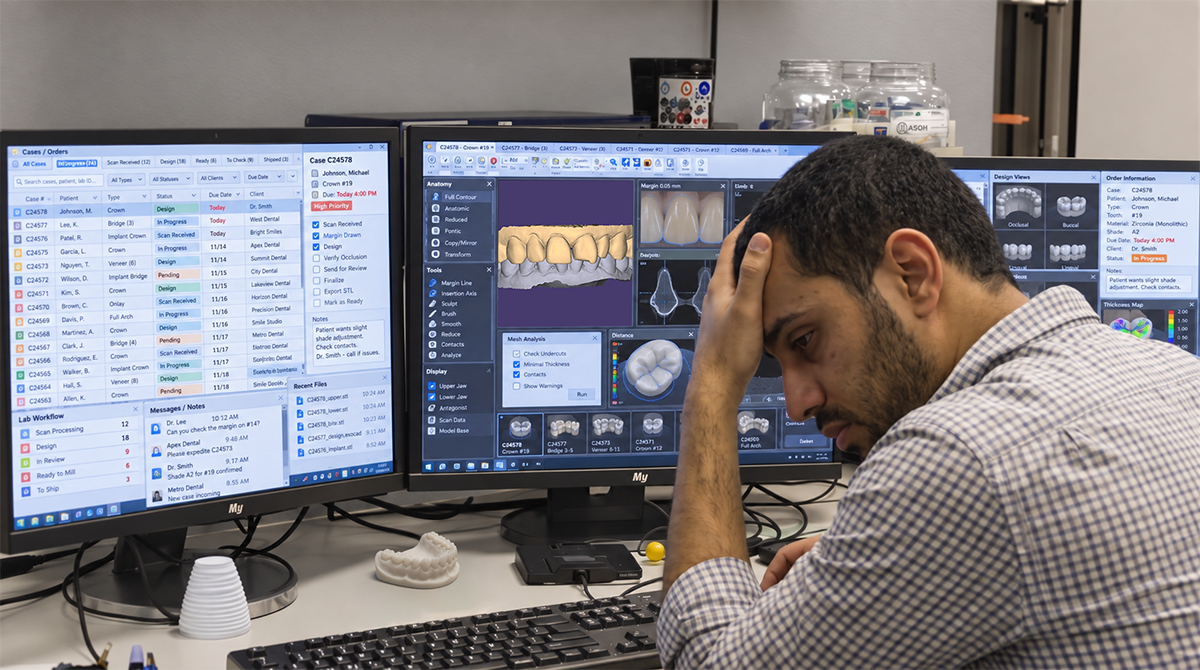
Dental CAD design is one of those tasks where saving a few minutes on a single case may not sound significant—until the same steps are repeated throughout the day. For dental technicians handling routine crowns alongside more demanding restorations, the real question is not whether AI can replace a technician. It is whether AI dental design can remove some of the repetitive work from the dental CAD workflow without creating more work later.
The practical answer starts with case selection. Straightforward cases may benefit from a faster first design step, while complex morphology, difficult occlusion, esthetic demands, or other case-specific requirements still call for closer technician involvement. AI works best when it cuts down on the grunt work, leaving experts firmly in charge.
Where Dental CAD Design Actually Saves Time
Not every case needs the same level of attention. A straightforward posterior crown and a case with complicated occlusion should not be treated as identical design tasks. This is where dental CAD CAM automation becomes practical: routine work can be separated from cases that still require closer technician control.
For simple indications, AI dental design can serve as a first design step rather than a replacement for professional judgment. The technician still reviews the margin, contacts, occlusion, and overall morphology before production. AMDC's current AI workflow similarly requires users to review the AI-detected margin and allows manual margin correction before generating and refining the tooth design.
That review step matters. A design that is generated quickly but requires extensive correction afterward does not necessarily improve production efficiency. The useful metric is not generation speed alone, but how efficiently the case moves from scan data to an acceptable design.
The Better Question: Which Cases Are Simple Enough?
The value of a faster dental CAD workflow depends heavily on case selection. If a case requires extensive adjustment after generation, the time saved at the beginning can quickly disappear.
That is why dental CAD CAM automation makes the most sense for predictable, relatively straightforward cases. Before sending a case into an AI-assisted workflow, technicians can ask a few practical questions:
- Is the scan data complete and clear enough to review the margin confidently?
- Is the occlusal situation relatively predictable?
- Does the case require extensive morphology customization?
- Is there a significant esthetic or case-specific requirement that needs closer manual control?
AMDC follows a similar distinction by positioning its AI-based option for simple cases while complex cases can be handled through its human design service. The current AMDC guide identifies the AI option as a simple-case workflow and the human design option as a complex-case workflow. This separation is important because useful automation starts with knowing when not to automate.
What Does “2-Minute AI Design” Really Mean for a Lab?
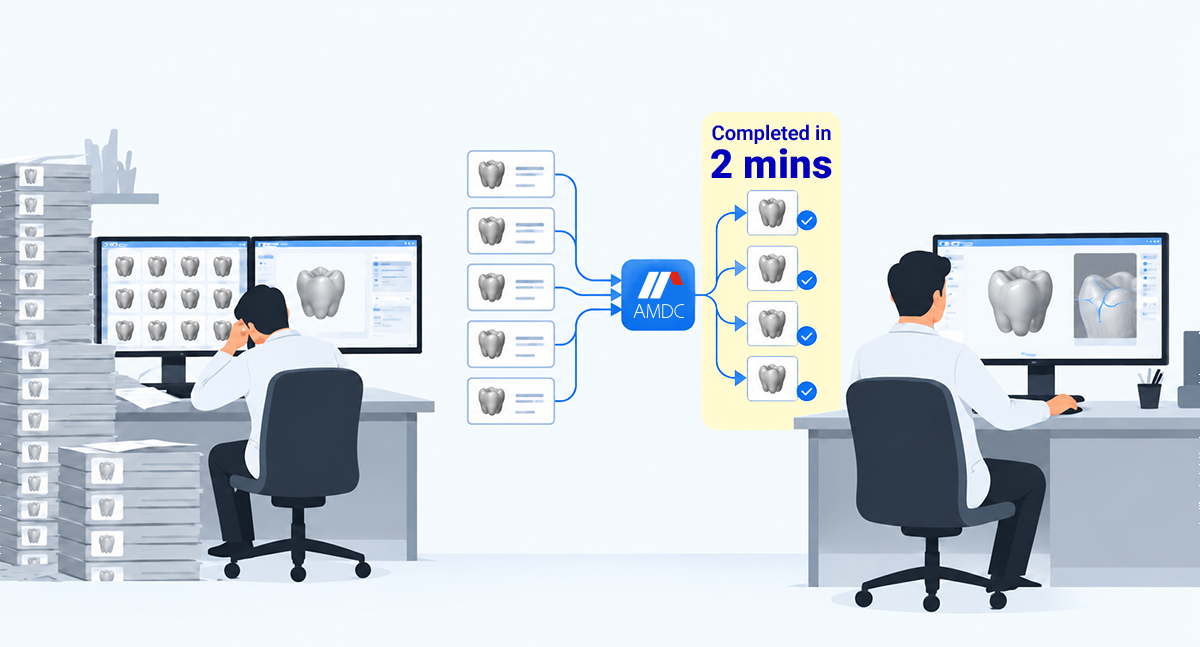
AMDC presents its simple-case AI dental design workflow as a process with an indicated design time of approximately two minutes. For a technician, however, the important point is not simply the “two minutes” itself. It is what can be done with the time that would otherwise be spent building a routine crown from the beginning.
A faster dental CAD workflow can help technicians shift more attention toward difficult morphology, esthetic cases, implant-related work, final review, or other tasks that benefit more from experienced judgment. That is a more practical way to think about AI in dental CAD design than expecting automation to handle every restoration.
The workflow should therefore be judged at the production level. If an AI-generated starting point reduces repetitive design work while remaining easy to review and refine, it may help. If the technician repeatedly needs to rebuild the result, the theoretical speed advantage becomes much less relevant.
Where the HASS Block Coupon Fits In
There is also a practical way for labs already using dental CAD CAM materials to test the workflow. AMDC provides product-linked Design Free Coupons with eligible HASSBIO product purchases. When purchasing eligible HASS CAD/CAM blocks, labs can check for the Design Free Coupon included with the product.
This makes the coupon more useful as a low-barrier workflow test than simply as a promotion. Instead of changing the entire dental CAD workflow, a technician can select an appropriate simple case, upload the required scan data, review the AI-detected margin, generate the design, and then check the result before production.
For a first test, the goal does not need to be proving that AI is faster in every situation. A more useful question is whether the workflow removes enough repetitive work on the right cases to justify including it in daily production.

AI Should Reduce Repetition, Not Remove Control
The most useful role for AI in a dental lab may be intentionally narrow. Dental CAD CAM technology does not need to automate every case to create value. It only needs to reduce unnecessary repetition where the case is predictable enough.
For that reason, a good dental CAD workflow still keeps the technician in control. Margin accuracy should be verified, contacts and occlusion should be reviewed, and generated morphology should receive professional evaluation before production. AMDC's own AI design instructions reinforce this approach by requiring margin review and providing manual correction and design-refinement steps.
When dental CAD design is approached this way, AI becomes less of a replacement story and more of a workflow tool. For labs processing a high number of routine cases, testing AI dental design on selected simple indications can be a practical way to determine where those two minutes actually matter.
The objective is not to remove the technician from digital dentistry. It is to reserve technician time for the decisions where experience adds the most value. For labs considering that balance, AMDC offers one workflow that can be evaluated alongside the lab's existing design process.
Explore how AMDC fits into your digital dental workflow and decide which cases make sense to test first.